
The first computer program Ryan Grant ever wrote moved a tiny hot air balloon around the blue screen of a Commodore 64. He was five years old.
Today, Dr. Grant, Sc’04, MSc’05, PhD’12, is helping Queen’s imagine something much bigger: a future in which Canada is not just using supercomputers, but leading the world in how they’re built, powered, shared, and applied.
It’s the kind of ambitious work the Research Excellence Fund helps make possible by supporting the people and tools that allow bold ideas to grow.
Supercomputers are essential research infrastructure. They allow researchers to run complex simulations, analyze massive datasets, and ask questions that ordinary computers can’t handle. That includes everything from climate modelling and artificial intelligence to drug discovery, personalized medicine, and astrophysics.
At Queen’s, that ambition is already taking shape.
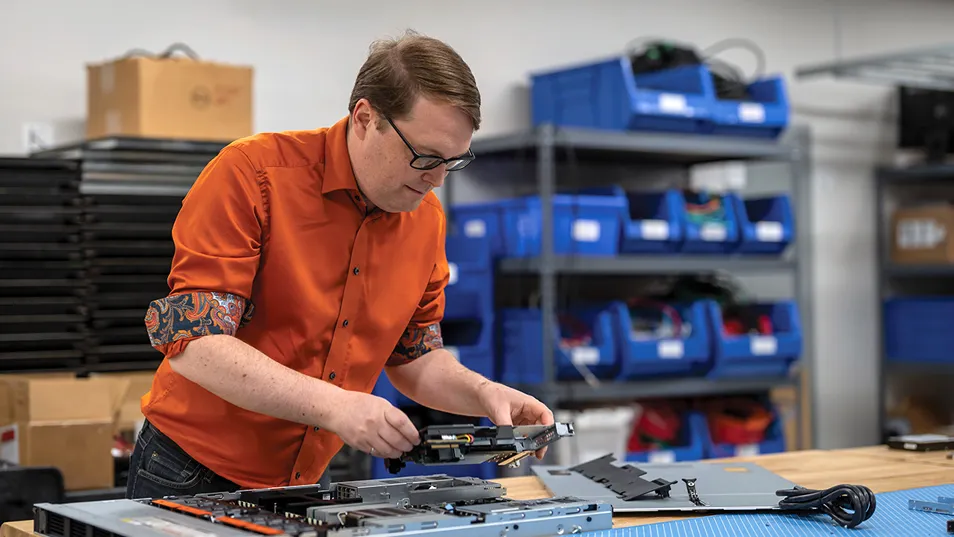
Dr. Grant, an associate professor in electrical and computer engineering, is helping lead efforts to build Canadian supercomputing capacity at Queen’s, with systems and expertise that can support research, artificial intelligence, and industry across the country.
One goal is especially bold: to help bring a supercomputer to Queen’s that would rank among the top 20 systems in the world.
Thanks to ongoing generosity to the Research Excellence Fund, researchers like Dr. Grant can access the equipment, shared tools, cross-disciplinary collaboration, and student research opportunities that help these kinds of big ideas move from possibility to real-world impact.
For supercomputing at Queen’s, that means helping build the expertise and infrastructure Canada needs to compete globally. Queen’s is doing that through the Centre for Advanced Computing, student training in Dr. Grant’s lab, national collaboration with Simon Fraser University, and plans with Bell Canada for a new supercomputing facility in Kingston.
For Dr. Grant, who returned to Queen’s after nine years at Sandia National Laboratories in the United States, the work is also personal.
“I’m glad to be back,” he says – back at Queen’s and back helping Canada build capacity in a field that will shape research, industry, and society for decades to come.